

A water-repellent jacket can be good for rain—but only when the rainfall, exposure time, and jacket construction match what the garment is designed to handle.
A jacket may make water bead beautifully on its surface and still be unsuitable for a long period of steady rain. Conversely, a jacket can stop producing obvious water beads while its waterproof membrane continues to prevent liquid water from passing through.
The reason is that water repellency and waterproofing solve different problems.
Water repellency primarily helps the outer fabric resist wetting. Waterproof construction is designed to prevent water from penetrating through the garment. For everyday commuters, hikers, outdoor workers, and rainwear buyers, understanding this difference is more useful than relying on a single label such as “water-repellent” or “waterproof.”
Water-Repellent Jacket Key Takeaways
- A water-repellent jacket is generally suitable for drizzle, mist, brief showers, and everyday outdoor use.
- DWR (Durable Water Repellent) helps water form droplets and roll off the outer fabric, but DWR alone does not make a jacket waterproof.
- Waterproof rainwear normally combines a waterproof membrane or coating with construction features that control water entry through seams, zippers, cuffs, and other openings.
- A surface water-repellency test and a waterproof-pressure test measure different properties. One test result should not be used as a substitute for another.
- When DWR wears down, the outer fabric may wet out. This can reduce comfort and, in some waterproof systems, affect moisture-vapor transport, but it does not automatically mean that the waterproof barrier has failed.
- The right rain jacket depends on rainfall intensity, exposure time, physical activity, and the consequences of getting wet—not simply on the highest advertised rating.
What Is a Water-Repellent Jacket?
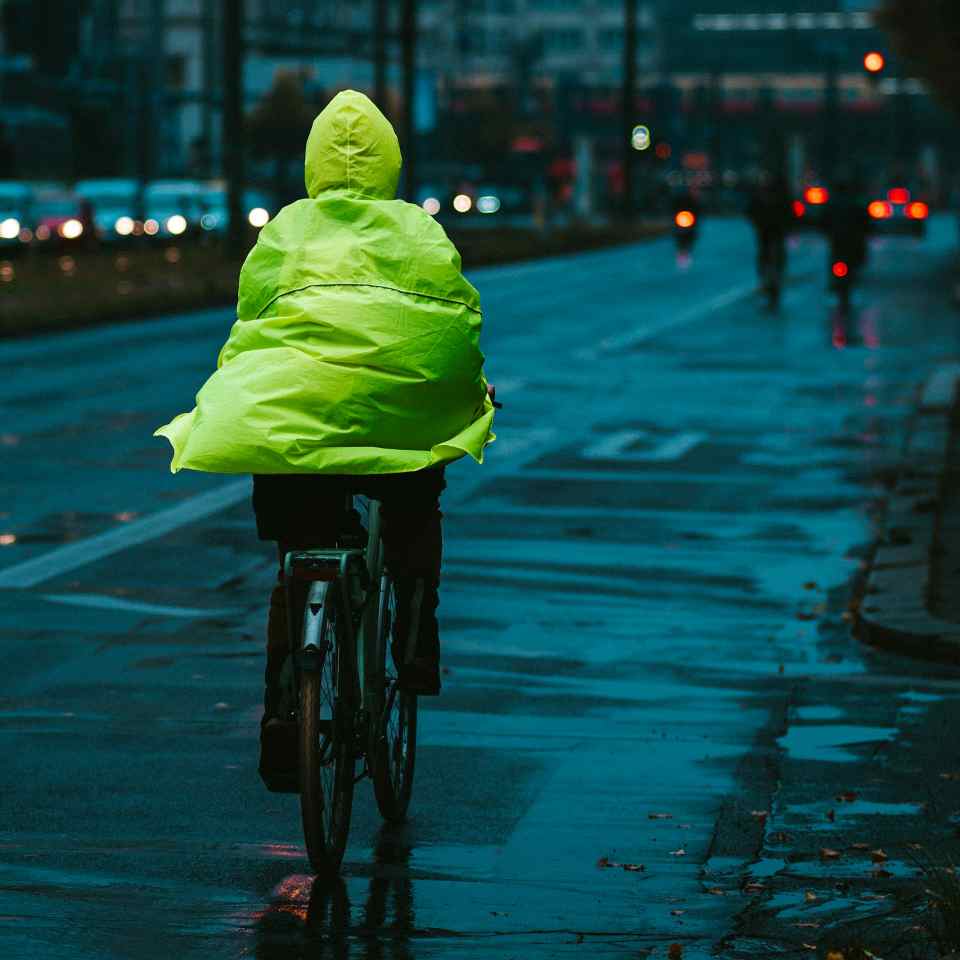
A water-repellent jacket has a surface that resists wetting by water.
The most familiar technology is a Durable Water Repellent (DWR) finish applied to the textile. When the finish is functioning properly, water tends to remain as droplets instead of rapidly spreading across the fabric.
That creates the familiar effect of rain “beading up” and rolling away.
But there is an important limitation:
Water beading tells you about the outer surface. It does not tell you how the complete jacket will perform during prolonged rainfall.
A jacket can have excellent surface water repellency but still allow water to pass through if the fabric itself is not waterproof. Likewise, a waterproof jacket may continue to provide substantial protection even after its DWR performance has declined.
This is why “water-repellent” should not automatically be interpreted as “waterproof.”
How DWR Makes Water Bead Up
DWR changes the surface characteristics of the textile so that water is less likely to spread and wet the fibers.
At the fabric surface, the treatment lowers the surface energy of the fibers. As a result, water tends to maintain a rounded droplet rather than spreading into a film across the textile.
In practical terms:
- Rain reaches the treated fabric.
- The surface resists rapid wetting.
- Water forms relatively compact droplets.
- Many droplets roll or slide away instead of immediately soaking into the outer fabric.
The result is useful for comfort and water management, but it is not the same thing as creating an impermeable barrier.
Why Does the Beading Effect Matter?
Surface beading has several practical benefits.
It can help reduce how quickly the outer fabric becomes saturated, keep the garment feeling lighter during short showers, and help maintain the intended performance of some layered waterproof systems.
However, a simple visual test has limits.
If you pour water onto a jacket and see it bead, you have demonstrated that the surface is repelling water at that moment. You have not demonstrated that the jacket can withstand hours of heavy rain, pressure from kneeling or leaning against wet surfaces, or water entering through seams and closures.
That distinction is particularly important when evaluating workwear.
Water-Repellent Jacket vs. Water-Resistant and Waterproof Jackets

These terms describe related but different levels or mechanisms of protection.
| Term | What it primarily describes | Suitable for | Main limitation |
|---|---|---|---|
| Water-repellent | Resistance to wetting at the fabric surface | Drizzle, mist, brief showers | Does not create a complete waterproof barrier |
| Water-resistant | Resistance to water penetration under specified conditions | Short or moderate wet-weather exposure, depending on construction | Performance depends on fabric, pressure, seams, and test method |
| Waterproof | Construction designed to prevent water penetration under defined test conditions | Sustained rain and demanding wet-weather use | Usually requires more complex construction and careful balance with breathability |
The most important point is that these categories cannot always be separated by appearance.
A buyer should ask:
- What is the fabric construction?
- Is there a waterproof coating or membrane?
- How are the seams protected?
- What test method supports the water-resistance claim?
- Is the test performed on the fabric or the finished garment?
- What conditions is the garment intended to withstand?
Those questions provide more useful information than the product label alone.
What Construction Features Matter?
A water-repellent finish is only one part of rainwear performance. The overall construction also determines how water can enter the garment.
Important details can include:
- Fabric construction
- Waterproof coating or membrane
- Seam sealing or taping
- Welded seams
- Zipper construction
- Storm flaps
- Hood coverage
- Adjustable cuffs
- Garment length
- Ventilation openings
This is especially important for professional rainwear because water can enter through seams, closures, and openings even when the main fabric has strong water-resistance properties.
How Does a Water-Repellent Jacket Use DWR to Repel Water?
DWR works by changing the surface characteristics of the textile so that water has less tendency to spread across the fibers.
The treatment does not simply create a physical wall that blocks water. Instead, it changes how water interacts with the fabric surface.
When the finish is effective, water tends to form droplets rather than spreading quickly across the textile.
This explains why a freshly treated jacket can appear highly water-repellent even though the fabric itself may not be fully waterproof.
What Happens at the Fabric Surface?
When rain reaches a DWR-treated fabric, the relationship between the water droplet and the textile surface is different from that of untreated fabric.
On untreated or easily wetted fabric, water can spread across the fibers and gradually saturate the outer surface.
On a DWR-treated surface, water tends to remain more concentrated in droplets. Gravity, movement, and the shape of the fabric can then help the droplets move away.
The effect is useful, but it has a defined limit:
DWR controls surface wetting; it does not by itself determine resistance to water penetration.
How Is Water-Repellent Jacket Performance Tested?
A commonly used method for assessing surface water repellency is AATCC TM22, Water Repellency: Spray Test.
The method evaluates the appearance of a fabric surface after water is sprayed onto it. The resulting wetting pattern is assessed against a standardized rating scale.
The important point is what the test actually measures.
AATCC TM22 evaluates surface wetting; it is not a complete test of rain penetration through a finished garment.
This makes the test useful for assessing DWR performance, but it should not be interpreted as proof that a jacket is waterproof.
For procurement teams, this distinction can prevent a common mistake: comparing a surface-repellency score from one garment with a hydrostatic-pressure result from another as though they were measuring the same property.
They are not.
What Does a Spray Test Tell You?
A spray test can help answer:
How readily does water wet the outer fabric?
That information is useful when assessing surface water repellency.
It does not directly answer:
How long can the complete jacket withstand continuous heavy rain?
The second question requires consideration of additional factors, including the fabric’s resistance to water penetration and the construction of the finished garment.
Why Test Methods Matter to B2B Buyers
When comparing rainwear suppliers, a specification without its test method can be difficult to interpret.
For example, a buyer may see a water-repellency score, a hydrostatic-pressure value, or a breathability figure. These numbers are only meaningful when the buyer knows what property was measured and under what method.
A stronger procurement process therefore asks for:
- Test standard
- Test method
- Test specimen
- Reported result
- Applicable garment or fabric
- Relevant test conditions
This makes supplier comparisons more objective.
What Happens When a Water-Repellent Jacket Loses DWR?
DWR is durable, but it is not permanent.
The finish can gradually lose effectiveness through:
- Repeated abrasion
- Backpack or equipment straps
- Seat belts
- Dirt and oily contamination
- Repeated laundering
- Improper detergents
- Certain chemical exposures
- General wear and environmental conditions
One of the easiest signs to recognize is a change in the way water behaves.
A new or well-maintained DWR-treated surface tends to produce distinct droplets. As the finish declines, water may spread across the fabric instead.
This is often called wetting out.
Does Wetting Out Mean the Jacket Is Leaking?
Not necessarily.
This is one of the most important distinctions when evaluating rainwear.
A garment with a waterproof membrane can have a wet outer face fabric while the waterproof barrier underneath is still preventing liquid water from passing through.
However, wetting out can make the garment feel colder, heavier, and less comfortable. In some waterproof breathable systems, saturation of the outer fabric can also interfere with the conditions needed for effective moisture-vapor transport.
Therefore:
Loss of DWR performance does not automatically equal failure of waterproof performance.
That distinction is more technically accurate than simply saying that a jacket becomes “non-waterproof” when the DWR wears off.
What Can Cause DWR to Wear Faster?
The rate of DWR degradation depends on how the garment is used and maintained.
A jacket repeatedly exposed to backpack straps, industrial equipment, vehicle seats, dirt, or frequent washing can experience more surface abrasion than a jacket used occasionally for city commuting.
This is why DWR durability should be considered in relation to the actual use environment.
For workwear buyers, the surface treatment is only one part of the product specification. Fabric durability, seam construction, garment design, and maintenance requirements also matter.
Can Water-Repellent Jacket DWR Be Restored?
Sometimes.
The appropriate maintenance method depends on the garment and the type of finish used.
A sensible approach is:
- Check the manufacturer’s care instructions.
- Clean the garment using the recommended washing method.
- Determine whether the existing finish can be reactivated according to the care instructions.
- If surface repellency remains poor, use a compatible reproofing product where appropriate.
- Avoid applying heat unless the manufacturer specifically allows it.
A common mistake is to treat every rain jacket as if it uses the same finish and membrane technology. It does not.
The garment’s care label should therefore take priority over generic DWR advice.
When Should You Consider Reproofing?
If cleaning and manufacturer-approved reactivation do not restore the expected surface beading, reproofing may be appropriate for some garments.
However, reproofing should not be viewed as a way to repair every type of rainwear failure.
If water is entering through:
- Damaged fabric
- Failed seam sealing
- Broken zippers
- Open construction points
- A damaged waterproof membrane
adding DWR to the outer surface will not solve the underlying problem.
This is another reason why surface water repellency and waterproof construction should be evaluated separately.
Water-Repellent Jacket vs. Waterproof Jacket: What Changes?
The biggest difference is the water barrier, not simply the DWR finish.
A basic water-repellent jacket may rely mainly on its textile and surface treatment. A waterproof garment normally incorporates an additional barrier, such as a waterproof coating or membrane, designed to resist liquid-water penetration.
The finished garment also has to address water entry through construction details.
| Construction Feature | Water-Repellent Jacket | Waterproof Jacket |
|---|---|---|
| DWR finish | Often used | Often used as part of the outer-face system |
| Waterproof membrane/coating | Not necessarily present | Commonly present |
| Resistance to sustained rain | Limited by fabric construction | Designed for greater resistance |
| Seam protection | Depends on garment | May use seam sealing, taping, or welded construction |
| Zipper/front protection | Basic or application-dependent | Often includes storm flaps or water-resistant zipper systems |
| Cuff protection | Application-dependent | Often designed specifically to reduce water entry |
| Breathability | Often relatively high because construction can be simpler | Depends strongly on membrane/coating and garment design |
| Weight and packability | Often lighter | Can be heavier or more structured |
This table also explains why there is no single “best” rain jacket.
A lightweight water-repellent jacket may be the better choice when comfort and mobility matter more than maximum rain protection. A waterproof rain suit becomes more appropriate when prolonged exposure is expected.
Why Seams Matter
Water does not only reach the garment through the main fabric.
A sewn seam contains needle holes, which can create potential pathways for water. Depending on the garment construction and intended performance level, manufacturers may use seam tape, sealing methods, or high-frequency welding to reduce these pathways.
For demanding rainwear, evaluating the seam construction can therefore be just as important as looking at the fabric specification.
What Does Hydrostatic Pressure Mean for a Water-Repellent Jacket?
Hydrostatic pressure is another important concept in rainwear specifications.
ISO 811:2018 describes a hydrostatic-pressure method for determining the resistance of textile fabrics to penetration by water.
In simplified terms, water pressure is applied to a fabric specimen, and the pressure at which water penetrates is evaluated.
This is fundamentally different from a spray test.
A spray test asks:
How readily does water wet the fabric surface?
A hydrostatic-pressure test asks:
How much water pressure can the tested material resist before water penetrates?
Both can be useful, but they answer different questions.
Why a Waterproof Number Is Not the Whole Story
Suppose two rain garments are advertised with different water-pressure figures.
That information may help you compare their tested resistance to water penetration, but it still does not tell you everything about the finished garment.
You should also consider:
- Seam construction
- Seam sealing or welding
- Zipper design
- Hood coverage
- Cuff design
- Garment length
- Fabric durability
- Fit and movement
- Test conditions
- Whether the reported result applies to fabric or finished garment
A garment can have a strong fabric-level result and still have practical leakage points elsewhere.
This is why professional rainwear evaluation should treat the garment as a system.
Does a Higher Waterproof Rating Make a Water-Repellent Jacket Better?
No.
A higher reported water-pressure value can indicate stronger resistance under the applicable test conditions, but “higher” does not automatically mean “better for every user.”
Consider two scenarios.
Scenario A: City commuting
The wearer walks for 15–30 minutes and can take shelter if rain becomes severe. A lightweight jacket with good surface repellency and adequate weather protection may be more comfortable than a heavy-duty rain suit.
Scenario B: Outdoor construction
The wearer may spend several hours outside while working, bending, lifting, and moving equipment. Rain can contact the garment continuously, and there may be no convenient shelter. Here, seam protection, closures, durability, ventilation, and complete waterproof construction become much more important.
The better garment is therefore the one that matches the exposure—not necessarily the one with the biggest number on its specification sheet.
Why the Highest Rating Is Not Always Necessary
More protection can also mean more weight, bulk, cost, or reduced flexibility.
A lightweight garment may be the better choice when the primary requirement is mobility during short periods of light rain.
A heavy-duty rain suit may be more appropriate when the primary requirement is sustained protection during outdoor work.
Rainwear should therefore be specified according to the actual operating environment.
Water-Repellent Jacket Breathability and Comfort
Rain protection creates another engineering challenge: the wearer also produces moisture.
During physical activity, perspiration and body heat need to escape. A garment that blocks external rain extremely well but provides poor moisture management can feel hot and clammy from the inside.
Breathability is commonly reported using moisture-vapor transmission measurements such as g/m²/24 h, but the number is meaningful only when the test method is also considered.
Different test methods can produce different results, so a “20K” breathability figure from one test method should not automatically be treated as directly equivalent to a “20K” result from another.
This is another area where simplistic rainwear comparisons can be misleading.
Why Can a Water-Repellent Jacket Feel More Comfortable?
A lightweight water-repellent jacket may have a relatively simple construction and no waterproof membrane. This can reduce bulk and make it comfortable during everyday movement.
That makes it attractive for:
- Walking
- Commuting
- Travel
- Casual outdoor use
- Short hikes
- Mild-weather activities
But comfort comes with a trade-off.
When rainfall becomes prolonged or intense, the same lightweight construction may no longer provide sufficient protection.
How Should Breathability Be Evaluated?
Do not compare breathability numbers without checking the test method.
Instead, consider:
- The reported moisture-vapor transmission result
- The test method
- Garment construction
- Ventilation openings
- Activity intensity
- Ambient temperature
- Expected duration of use
A garment with a moderate laboratory breathability value may still feel comfortable in one application, while another garment with a higher value may not feel comfortable if the wearer is working at high intensity in warm conditions.
When Should You Choose a Water-Repellent Jacket?
A water-repellent jacket can be an appropriate choice when rain exposure is limited and complete waterproof protection is not required.
Typical applications include:
- Light drizzle
- Short showers
- City commuting
- Travel
- Casual outdoor use
- Short hikes
- Mild-weather activities
The main advantages can include lower weight, easier movement, packability, and comfort.
However, when exposure becomes longer or more severe, the requirements change.
When Is a Water-Repellent Jacket Enough for Commuting?
For a short city commute, a water-repellent jacket may provide an effective balance of protection and comfort.
If the wearer can quickly reach indoor shelter and the expected weather consists mainly of drizzle or brief showers, a lightweight garment may be sufficient.
If the commute involves cycling or walking for a long period with no shelter, a waterproof garment may provide a better margin of protection.
When Is a Water-Repellent Jacket Suitable for Hiking?
For short hikes in mild or changeable weather, a water-repellent jacket may be useful.
For full-day hikes, exposed trails, or areas where rainfall can continue for hours, a waterproof shell generally provides greater protection.
The key factor is not the activity name itself. It is the combination of exposure duration, weather conditions, activity intensity, and access to shelter.
How to Choose a Water-Repellent Jacket for Different Rain Conditions
Instead of asking whether one jacket is universally better, match the garment to the expected conditions.
| Use Case | Recommended Protection | Why |
|---|---|---|
| Light drizzle | Water-repellent | Surface repellency is usually sufficient |
| Short city commute | Water-repellent or lightweight waterproof | Depends on forecast and exposure |
| Travel in changeable weather | Lightweight waterproof shell | Provides a larger safety margin |
| Short outdoor activity | Water-repellent or waterproof | Depends on rainfall and activity level |
| Long hike in wet weather | Waterproof | Longer exposure increases the need for a barrier |
| Heavy downpour | Waterproof | Surface repellency alone is insufficient |
| Construction work | Heavy-duty waterproof rainwear | Continuous exposure and movement increase demands |
| Marine or wet industrial work | Purpose-designed waterproof workwear | Protection needs are higher and exposure can be prolonged |
A Simple 4-Question Rainwear Test
Before choosing a jacket, ask four questions.
1. How much rain should it handle?
Drizzle is fundamentally different from continuous heavy rain.
2. How long will the wearer remain outside?
A jacket that works for a short commute may be inadequate for an entire outdoor shift.
3. How active will the wearer be?
Higher activity increases the importance of ventilation and moisture management.
4. What is the consequence of getting wet?
For a casual walk, getting damp may simply be uncomfortable.
For construction, marine operations, utilities, logistics, or other outdoor work, inadequate rain protection can have much greater practical consequences.
This framework is more useful than selecting a garment solely by its marketing category.
What Should B2B Buyers Check When Sourcing a Water-Repellent Jacket?
For businesses purchasing rain jackets or rain suits in volume, product evaluation should be more systematic than simply requesting a catalog and comparing prices.
Ask the supplier for:
- Fabric composition
- Fabric weight
- Waterproof or water-resistance specifications
- Applicable test methods
- Hydrostatic-pressure results where relevant
- Seam construction
- Seam sealing, taping, or welding details
- DWR information
- Breathability test method and result
- Garment-care requirements
- Available sizes
- Color options
- Custom branding capability
- Sample approval process
- Production lead time
- Quality-control procedures
- Packaging and labeling options
This information gives purchasing teams a clearer basis for comparing suppliers.
It also helps prevent a common sourcing problem: buying a garment described as “waterproof” without knowing what was actually tested and under what conditions.
What Should Buyers Ask About Testing?
Instead of asking only:
“Is this jacket waterproof?”
Ask more specific questions:
- What waterproof test standard is used?
- Is the reported result for the fabric or finished garment?
- What is the hydrostatic-pressure result?
- How are seams protected?
- Are the seams taped or welded?
- What test method was used for breathability?
- What is the expected application?
- How should the garment be maintained?
These questions turn a general product claim into measurable purchasing criteria.
How Does a Heavy-Duty Water-Repellent Jacket Compare With a Rain Suit?
Heavy-duty rain suits are designed for a different use case from lightweight everyday jackets.
For professional outdoor work, construction details can matter as much as the fabric itself.
For example, the Welwork Heavy Duty Rain Suit information supplied for this article specifies high-frequency welded seams, a 5,000–8,000 mm hydrostatic-pressure range, double storm-front protection, adjustable Velcro cuffs, and underarm vents.
These specifications are relevant because they address different parts of the rain-protection problem:
- Welded seams reduce potential leakage through stitched areas.
- A stated hydrostatic-pressure range provides a measurable indication of water-penetration resistance under the applicable test conditions.
- A double storm front provides additional protection around the front closure.
- Adjustable cuffs help reduce exposure around the wrists.
- Underarm vents provide a way to improve airflow during physical work.
For B2B buyers, however, these specifications should be evaluated against the intended application rather than treated as universal proof that one rain suit is suitable for every environment.
The relevant questions remain: How long will workers be exposed to rain? How active are they? What temperatures are expected? What other hazards are present? What level of durability is required?
Why Heavy-Duty Rainwear Needs More Than DWR
A heavy-duty work garment cannot depend solely on surface water repellency.
When workers are exposed to rain for extended periods, the garment needs to manage water entry through multiple potential paths.
That is why features such as welded seams, storm-front construction, adjustable cuffs, and ventilation become important parts of the overall design.
DWR can still contribute to surface water management, but it should be viewed as one component rather than the entire waterproof system.
Why Water-Repellent Jacket Specifications Need Context
Rainwear specifications are most useful when they answer a real purchasing question.
For example:
“Does this jacket have DWR?”
Useful for understanding surface water management.
“What is the hydrostatic-pressure result?”
Useful for understanding resistance to water penetration under the stated test conditions.
“Are the seams welded or taped?”
Useful for evaluating potential leakage paths.
“What breathability test was used?”
Useful for comparing moisture-management claims correctly.
“What is the intended application?”
Useful for deciding whether the specifications are appropriate in the first place.
This is the difference between reading specifications and actually evaluating rainwear.
Why Fabric Specifications Alone Are Not Enough
The same fabric can behave differently in different garment constructions.
A fabric specification does not automatically tell you:
- How seams are finished
- How closures are protected
- How much coverage the garment provides
- Whether the hood prevents water entry
- Whether cuffs can be adjusted
- How the garment behaves during movement
- Whether the garment remains comfortable during extended work
For this reason, B2B buyers should evaluate the complete finished garment, not just the fabric data sheet.
Water-Repellent Jacket FAQ
Is a water-repellent jacket good for light rain?
Yes. A well-maintained water-repellent jacket is generally suitable for drizzle, mist, and short showers. Its DWR finish helps prevent the outer fabric from becoming wet immediately.
Is water-repellent the same as waterproof?
No. Water repellency primarily concerns resistance to wetting at the outer surface. Waterproofing concerns resistance to water penetration through the garment.
Does DWR make a jacket waterproof?
No. DWR is a surface treatment. It can improve the way rain interacts with the outer fabric, but it does not replace a waterproof membrane or coating.
What does it mean when water stops beading on my water-repellent jacket?
It usually means that the surface water-repellent performance has declined. Dirt, abrasion, washing, and other forms of wear can reduce DWR effectiveness.
If DWR wears off, is the water-repellent jacket no longer waterproof?
Not necessarily. If the jacket has a separate waterproof membrane or coating, the waterproof barrier may continue to function even when the outer fabric wets out.
Can DWR on a water-repellent jacket be restored?
In many cases, surface water repellency can be improved through appropriate cleaning, reactivation, or reproofing. Always follow the garment manufacturer’s care instructions because treatments and fabrics differ.
What is the difference between AATCC TM22 and hydrostatic-pressure testing?
AATCC TM22 evaluates the tendency of a fabric surface to become wetted when sprayed with water. Hydrostatic-pressure testing evaluates resistance to water penetration under applied pressure. They measure different properties and should not be used interchangeably.
Is a 10K waterproof rating enough for heavy rain?
A 10K figure alone does not determine whether a jacket is suitable for a particular heavy-rain environment. The test method, seam construction, closures, garment design, exposure time, and intended use should also be considered.
Is a water-repellent jacket better for active use?
It can be, particularly in mild conditions where the wearer values low weight, mobility, and comfort. For prolonged heavy rain, however, a waterproof garment generally provides a higher level of protection.
What should businesses ask a water-repellent jacket manufacturer?
B2B buyers should request the relevant fabric and garment specifications, test methods, seam-construction details, sample information, customization options, quality-control documentation, and production terms. This makes supplier comparisons more objective.


