

In high-risk heavy and highway construction environments, high-visibility safety apparel (HVSA) acts as a critical engineering control against struck-by hazards—consistently ranked by the Occupational Safety and Health Administration (OSHA) as one of the “Focus Four” leading causes of workplace fatalities.
The widespread deployment of fluorescent orange clothing is not a matter of style; it is an engineered choice driven by human factors, strict federal mandates, and optical physics. Bright fluorescent backgrounds combined with retroreflective materials ensure that workers remain visible to motorists and heavy machinery operators from vital stopping distances under all ambient light conditions.
Key Takeaways
- Chromatic Contrast Engineering: Fluorescent orange-red offers optimal contrast against grey asphalt, concrete barriers, urban backdrops, and active work zone devices.
- Codified Regulatory Compliance: Effective deployment must legally align with specific Performance Classes and Garment Types dictated by the ANSI/ISEA 107-2020 standard.
- Federal Mandates: OSHA actively enforces high-visibility compliance by incorporating the Federal Highway Administration’s (FHWA) Manual on Uniform Traffic Control Devices (MUTCD).
- Textile Performance & Ergonomics: Modern industrial fabrics utilize advanced polyester and nylon weaves to maximize breathability, tear resistance, and UV stability.
- Quantitative Lifespan Limits: High-visibility properties degrade due to environmental exposure; standard field consensus limits daily-wear garments to an approximate six-month lifespan.
The Science of Conspicuity: Why Fluorescent Orange Protects the Construction Worker
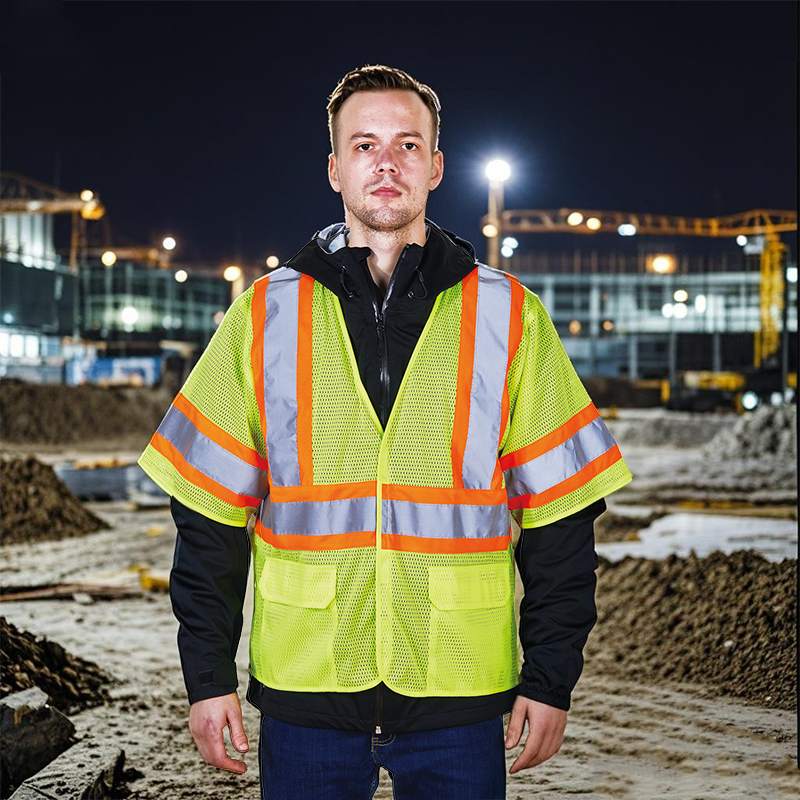
Contrast Against Technical and Natural Backgrounds
On an active construction site, visibility relies on conspicuity—the biological probability that an object will rapidly draw the attention of an observer in a complex environment. Fluorescent materials work by absorbing invisible, short-wave ultraviolet (UV) sunlight and re-emitting it as longer waves of visible light. This makes the garment appear to actively glow during daylight, dawn, and dusk.
While fluorescent yellow-green is highly sensitive to the human eye, fluorescent orange-red is strategically mandated for specific environments. According to human factors engineering, orange triggers an instant cognitive association with “caution,” “barricade,” and “temporary hazard.” Furthermore, it provides superior contrast in environments heavily saturated with green foliage or gray industrial structures.
High-Visibility Fluorescent Color Comparison Matrix:
| Chromatic Factor | Fluorescent Yellow-Green | Fluorescent Orange-Red |
| Daylight Luminance Factor (Y %) | Minimum 70% (Highest perceived brightness) | Minimum 40% (High contrast against sky/asphalt) |
| Urban & Infrastructure Contrast | Excellent against dark asphalt or soil. | Superior against concrete barriers, steel, and city infrastructure. |
| Natural Background Contrast | Risk of blending with bright green foliage in summer. | Exceptional contrast; never blends with foliage, sand, or winter snow. |
| Low-Light / Twilight Performance | Performs optimally in deep twilight and shade. | Maintains distinct contrast under vehicle headlights and artificial light. |
| Standard Deployment (MUTCD Focus) | Widely used for general construction, utility crews, and sanitation. | Heavily utilized in highway roadwork, temporary traffic zones, and rail. |
Struck-By Hazard Mitigation
Data from the Bureau of Labor Statistics (BLS) and the National Institute for Occupational Safety and Health (NIOSH) indicates that hundreds of fatal struck-by injuries occur annually in work zones. A driver traveling at 65 mph covers approximately 95 feet per second. High-visibility apparel increases the recognition distance of a human silhouette up to 1,280 feet, granting operators ample time to perceive, react, and safely brake.
Legal Standards and Compliance: ANSI & OSHA Standards Mandated for the Construction Worker
To offer legitimate, standard-grade protection, a safety garment must adhere to exact geometric and photometric performance thresholds.
ANSI/ISEA 107-2020 Design Categories
The American National Standard for High-Visibility Safety Apparel and Accessories (ANSI/ISEA 107-2020) designates garments by both Type (based on work setting) and Performance Class (based on material square footage):
Garment Types:
- Type O (Off-Road): For occupational environments where workers are exposed to traffic or heavy equipment but not on public rights-of-way (e.g., warehouses, refineries).
- Type R (Roadway): Explicitly for workers exposed to public vehicular traffic or temporary traffic control zones along roadways.
- Type P (Public Safety): For emergency responders, law enforcement, and incident management personnel.
Performance Classes:
- Class 1 (Type O Only): Provides the minimum required material. Suitable for environments where vehicle speeds do not exceed 25 mph and tasks permit full worker attention.
- Class 2 (Type R/P): The baseline requirement for roadway construction. Requires at least 775 square inches of fluorescent background fabric and 201 square inches of retroreflective tape (minimum 1.375-inch width).
- Class 3 (Type R/P): Mandated for high-risk, high-speed zones (speeds exceeding 50 mph), nighttime operations, or when workers face extreme attention deficits. Requires a minimum of 1,240 square inches of background fabric and 310 square inches of retroreflective tape (minimum 2-inch width). Class 3 garments must include high-visibility material on the sleeves or lower limbs to map the human form during movement.
- Class E (Supplemental): Pants, shorts, or gaiters that do not meet standalone high-vis criteria. However, when a Class 2 vest is combined with Class E trousers, the ensemble is legally certified as a Class 3 Ensemble.
OSHA Enforceable Framework
OSHA enforces high-visibility compliance through specific statutory regulations and national consensus standouts:
- 29 CFR 1926.201(a) (Signaling): Explicitly mandates that flaggers must wear warning garments meeting the requirements of the Federal Highway Administration’s Manual on Uniform Traffic Control Devices (MUTCD).
- 29 CFR 1926.651(d) (Excavations): Mandates that any employee exposed to public vehicular traffic during excavation or trenching operations must be provided with and wear warning vests made of reflectorized or high-visibility material.
- The OSH Act General Duty Clause (Section 5(a)(1)): OSHA legally issues serious citations under this clause to employers who fail to provide ANSI-compliant high-visibility apparel to employees working in any recognized struck-by hazard zone, even if a specific vertical standard is missing.
Material Science: Durability and Performance in Construction Worker Gearbility and Field Performance
Industrial construction zones present severe environmental stressors—UV radiation, concrete dust, petrochemicals, and abrasive friction—all of which break down fluorescent polymers and retroreflective structures over time.
Industrial Textile Comparison Matrix
| Textile Base Material | Abrasion & Puncture Resistance | Breathability Index | Environmental & UV Performance |
| Woven Solid Polyester | High tensile strength; resists stretching and mechanical deformation. | Moderate; ideal for cooler seasons or structural tool-vest applications. | Excellent dye retention; tightly holds fluorescent molecules under intense UV exposure. |
| Polyester Mesh | High tear resistance relative to total fabric mass. | Maximum; open-grid weave allows rapid metabolic heat dissipation. | Lightweight and quick-drying; prevents heat stress in high-ambient summer zones. |
| Heavy-Duty Nylon | Maximum abrasion and puncture protection. | Low; dense weave limits airflow. | Exceptional structural longevity in high-friction environments; heavier hand-feel. |
| Modacrylic / Treated Cotton | Moderate to high. | High skin comfort and moisture absorption. | Inherently Flame-Resistant (FR); legally mandated for utility, arc-flash, and petrochemical zones. |
Technical Engineering Components
Professional safety apparel integrates structural components engineered for active jobsites:
- Retroreflective Technology: Utilizes either glass-bead technology or micro-prismatic polymers compliant with ANSI/ISEA 107 Section 8 to direct light straight back to vehicle headlights (retroreflection) rather than scattering it.
- 5-Point Breakaway Architecture: Features hook-and-loop closures at the front, shoulders, and sides. If the garment is snagged by moving machinery parts or passing vehicles, it shears off instantly, preventing the worker from being dragged.
- Dimensional Stability: High-quality industrial garments undergo pre-treatment to ensure shrinkage does not exceed 3% after multiple laundering cycles, keeping reflective bands properly positioned relative to the worker’s anatomy.
Field Maintenance, Inspection, and Replacement Protocols for the Construction Worker

An HVSA garment loses its legal compliance the moment its visibility factors fall below standard thresholds. Employers are responsible for implementing structured inspection protocols.
Service Life Reality: Neither ANSI nor OSHA mandates an explicit expiration date stamped on safety vests. However, comprehensive field studies conducted by the FHWA and ISEA reveal that an HVSA garment worn daily in typical outdoor construction conditions has an effective useful service life of approximately 6 months. Vests used in clean, indoor, or occasional environments may last up to 2 years.
Mandatory Inspection Criteria
A safety vest must be immediately retired and replaced if it exhibits any of the following:
- Fluorescent Fading: When the background fabric loses its neon brilliance and shifts toward a dull hue, reducing daytime conspicuity.
- Retroreflective Degradation: If the reflective silver bands are cracked, heavily scratched, or rubbed off, rendering them invisible under nighttime headlight testing.
- Permanent Soiling: Accumulation of grease, asphalt tar, concrete dust, or paint that covers more than a total of 2 inches of the required high-vis surfaces.
- Structural Compromise: Torn panels, missing fasteners, or alterations that reduce the total surface area of compliant fabric below the ANSI Class threshold.
Conclusion
High-visibility orange apparel is far more than a passive safety recommendation; it is an engineered, legally codified engineering control designed to minimize workplace fatalities. In complex, high-speed construction environments, the stark contrast of fluorescent orange provides passing motorists and heavy equipment operators with the vital visual cues needed to prevent catastrophic struck-by incidents.
For safety managers and project supervisors, ensuring compliance requires strict adherence to ANSI/ISEA 107 performance classes and a precise understanding of the operational parameters enforced by OSHA. By prioritizing professionally certified, ergonomically sound apparel—and instituting clear replacement cycles for worn gear—construction enterprises protect their most valuable asset: their workforce. Ultimately, consistent deployment of high-visibility gear ensures that at the end of every shift, every construction worker returns home safely.
FAQ
Who is financially responsible for providing ANSI-compliant high-visibility vests?
Under OSHA Standard 29 CFR 1910.132(h), employers are legally required to provide Personal Protective Equipment (PPE)—including high-visibility safety apparel—at no cost to the employee whenever it is required to mitigate workplace hazards.
Can a high-visibility vest be worn over heavy winter gear?
Yes. However, the employer must ensure the vest is sized appropriately to fit over winter outerwear without bunching or obscuring the 360-degree orientation of the reflective bands. If the vest cannot close fully over a winter jacket, it violates ANSI design requirements.
What are the precise laundering instructions to prevent damaging the reflective elements?
Garments should be washed inside out on a gentle cycle utilizing a mild, bleach-free, and neutral detergent. High heat completely destroys micro-prismatic and glass-bead retroreflective structures. Therefore, the garment must be air-dried or tumble-dried on a zero-heat setting. Never iron or dry-clean reflective components.
Are there specific penalties for failing to wear required high-visibility apparel?
Yes. OSHA issues serious violations for missing or non-compliant PPE, which carry steep financial penalties per instance. Furthermore, a failure to enforce HVSA compliance significantly increases corporate liability and can result in the denial of insurance claims following an incident.


